GALEX Images
-
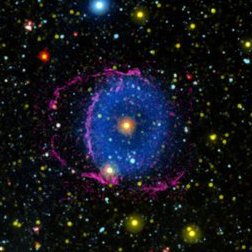
Blue Ring Nebula
The Blue Ring Nebula is thought to be a short-lived phase after the merger of two stars.
-
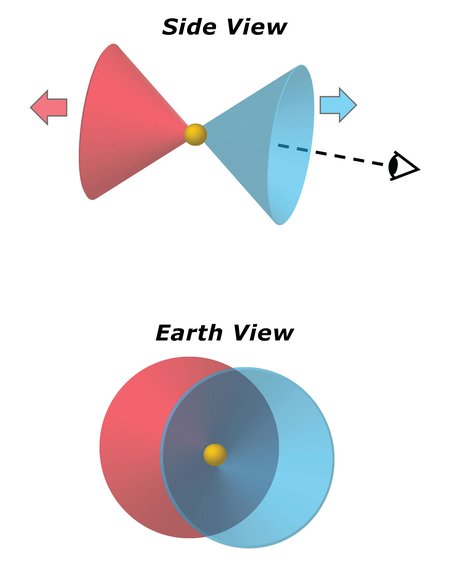
Blue Ring Nebula Overlapping Cones
The Blue Ring Nebula consists of two hollow, cone-shaped clouds of debris moving in opposite directions away from the central star.
-
Flaring Red Dwarf Star
This illustration shows a red dwarf star orbited by a hypothetical exoplanet. Red dwarfs tend to be magnetically active, displaying gigantic arcing prominences and a wealth of dark sunspots.
-
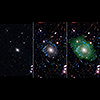
Frankenstein Galaxy
The galaxy UGC 1382 has been revealed to be far larger and stranger than previously thought. Astronomers relied on a combination of ground-based and space telescopes to uncover the true nature of this "Frankenstein galaxy".
-
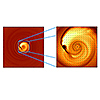
Intricate Dance of Black Holes
This simulation helps explain an odd light signal thought to be coming from a close-knit pair of merging black holes, PG 1302-102, located 3.5 billion light-years away.
-
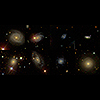
After the Explosion: Investigating Supernova Sites
A new study analyzes several sites where dead stars once exploded. The explosions, called Type Ia supernovae, occurred within galaxies, six of which are shown in these images from the Sloan Digital Sky Survey.
-
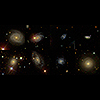
After the Explosion: Investigating Supernova Sites (Annotated)
A new study analyzes several sites where dead stars once exploded. The explosions, called Type Ia supernovae, occurred within galaxies, six of which are shown in these images from the Sloan Digital Sky Survey.
-
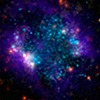
Sluggish Galaxy Grows Stars Slowly
A small galaxy, called Sextans A, is shown here in a multi-wavelength mosaic captured by the European Space Agency's Herschel mission, in which NASA is a partner, along with NASA's Galaxy Evolution Explorer and the National Radio Astronomy Observatory's Jansky Very Large Array observatory near Socorro, New Mexico.
-
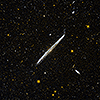
Galaxy's Pencil-Thin Profile
This image from NASA's Galaxy Evolution Explorer shows NGC 4565, one of the nearest and brightest galaxies not included in the famous list by 18th-century comet hunter Charles Messier.
-
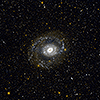
Ultraviolet Ring of Stars
This image from NASA's Galaxy Evolution Explorer shows Messier 94, also known as NGC 4736, in ultraviolet light. It is located 17 million light-years away in the constellation Canes Venatici.
-
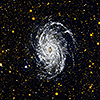
Big Brother to the Milky Way
This image from NASA's Galaxy Evolution Explorer shows NGC 6744, one of the galaxies most similar to our Milky Way in the local universe.
-

Dwarf Galaxy Spotted
This composite of the giant barred spiral galaxy NGC 6872 combines visible light images from the European Southern Observatory's Very Large Telescope, NASA's GALEX and NASA's Spitzer Space Telescope.
-
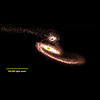
Simulation of Galactic Collision
Computer simulations of the collision between NGC 6872 and IC 4970 reproduce the basic features of the galaxies as we see them today.
-
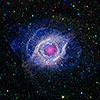
The Helix Nebula: Unraveling at the Seams
A dying star is throwing a cosmic tantrum in this combined image from NASA's Spitzer Space Telescope and the Galaxy Evolution Explorer (GALEX)
-
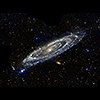
The Galaxy Next Door
Hot stars burn brightly in this new image from NASA's Galaxy Evolution Explorer, showing the ultraviolet side of a familiar face.
-
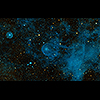
Plowing Through the Depths of Space
A runaway star, plowing through the depths of space and piling up interstellar material before it, can be seen in this ultraviolet image from NASA's Galaxy Evolution Explorer.
-
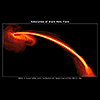
Black Hole Erupts
This computer-simulated image shows gas from a tidally shredded star falling into a black hole. Some of the gas also is being ejected at high speeds into space.
-
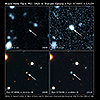
Black Hole Swallows a Star
These images, taken with NASA's Galaxy Evolution Explorer and the Pan-STARRS1 telescope in Hawaii, show a brightening inside a galaxy caused by a flare from its nucleus.
-
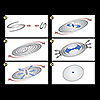
Timeline of the Rise and Fall of NGC 3801
This diagram sketches out the stages leading up to NGC 3801's current observed state and beyond.
-
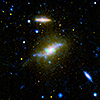
The Beginning of the End of Star Formation
Time is running out for the galaxy NGC 3801, NASA's Galaxy Evolution Explorer and other instruments have helped catch the galaxy NGC 3801 in the act of destroying its cold, gaseous fuel for new stars.
-
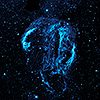
Cygnus Loop Nebula
Wispy tendrils of hot dust and gas glow brightly in this ultraviolet image of the Cygnus Loop nebula, taken by NASA's Galaxy Evolution Explorer.
-

Galactic Train Wrecks
This montage shows three examples of colliding galaxies from a new photo atlas of galactic "train wrecks".
-
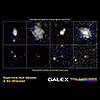
Little Galaxies Pack a Big Punch
These postage-stamp images were taken by the ultraviolet-sensing GALEX -- the top row shows four galaxies that each produced a typical supernova, while the bottom row shows four galaxies that each produced an ultra-bright supernova.
-

Planets Under a Red Sun
This artist's concept illustrates a young, red dwarf star surrounded by three planets. Such stars are dimmer and smaller than yellow stars like our sun, which makes them ideal targets for astronomers wishing to take images of planets outside our solar system, called exoplanets.
-
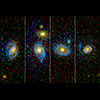
Ultraviolet Ring around the Galaxies
Astronomers have found unexpected rings and arcs of ultraviolet light around a selection of galaxies, four of which are shown here as viewed by NASA's and the European Space Agency's Hubble Space Telescope.
-

Now You See a Tail, Now You Don't
NASA's Galaxy Evolution Explorer found a tail behind a galaxy called IC 3418. The star-studded tail can be seen on the left, as detected by the space telescope in ultraviolet light.
-

A Lesson in Counting Stars
These two photographs were made by combining data from NASA's Galaxy Evolution Explorer spacecraft and the Cerro Tololo International Observatory in Chile.
-

Adding up Stars in a Galaxy
This diagram illustrates the extent to which astronomers have been underestimating the proportion of small to big stars in certain galaxies.
-
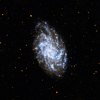
NASA's Galaxy Mission Celebrates Sixth Anniversary
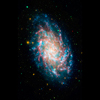
The image shows a map of the recent star formation history of M33.
-
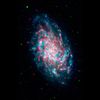
NASA's Galaxy Mission Celebrates Sixth Anniversary
This image is a blend of the Galaxy Evolution Explorer's M33 image and another taken by NASA's Spitzer Space Telescope.
-
NASA's Galaxy Mission Celebrates Sixth Anniversary
This image is a blend of the Galaxy Evolution Explorer's M33 image and another taken by NASA's Spitzer Space Telescope.
-

The Extended Region Around the Planetary Nebula NGC 3242
This new image of the 'Ghost of Jupiter' is being released as part of the 'Around the World in 80 Telescopes' event for the International Year of Astronomy.
-
Seeing Baby Dwarf Galaxies
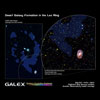
The unique ultraviolet vision of NASA's Galaxy Evolution Explorer reveals, for the first time, dwarf galaxies forming out of nothing more than pristine gas likely leftover from the early universe.
-

'Ghost of Mirach' Rears its Spooky Head
The "Ghost of Mirach" galaxy is shown in visible light on the left, and in ultraviolet as seen by NASA's Galaxy Evolution Explorer on the right.
-
A Cosmic Embrace
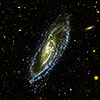
From 22 million light-years away, galaxy M106 extends two ultraviolet-bright spiral arms in this image from NASA's Galaxy Evolution Explorer.
-

Beyond the Borders of a Galaxy
The outlying regions around the Southern Pinwheel galaxy, or M83, are highlighted in this composite image from NASA's Galaxy Evolution Explorer and the National Science Foundation's Very Large Array in New Mexico.
-
What Lies Beyond the Edge of a Galaxy
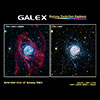
This side-by-side comparison shows the Southern Pinwheel galaxy, or M83, as seen in ultraviolet light (right) and at both ultraviolet and radio wavelengths (left).
-
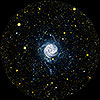
Ultraviolet Extensions
This ultraviolet image from NASA's Galaxy Evolution Explorer shows the Southern Pinwheel galaxy, also know as Messier 83 or M83.
-

Andromeda, the Galaxy Next Door
At approximately 2.5 million light-years away, the Andromeda Galaxy, or M31, is our Milky Way's largest galactic neighbor.
-
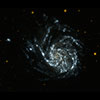
Structural Integrity of the Pinwheel Galaxy
The structural integrity of M101, or the Pinwheel Galaxy, is revealed in this classic image from GALEX.
-
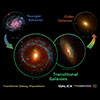
Portrait of a Galaxy's Life
New evidence from NASA's Galaxy Evolution Explorer supports the long-held notion that many galaxies begin life as smaller spirals before transforming into larger, elliptical-shaped galaxies.
-
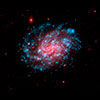
NGC 300
This image from NASA's Galaxy Evolution Explorer shows the galaxy NGC 300, located about seven million light-years away in the constellation Sculptor.
-
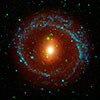
NGC 1291
This image from NASA's Galaxy Evolution Explorer shows the galaxy NGC 1291, located about 33 million light-years away in the constellation Eridanus.
-
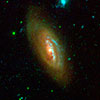
NGC 4569
This image from NASA's Galaxy Evolution Explorer shows the galaxy NGC 4569, located about four million light-years away in the constellation Virgo.
-
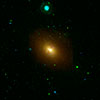
NGC 1316
This image from NASA's Galaxy Evolution Explorer shows the galaxy NGC 1316, located about 62 million light-years away in the constellation Fornax.
-

NGC 4522 Stripped
This image from NASA's Galaxy Evolution Explorer shows galaxy NGC4522 being stripped of its star-forming material.
-

Johnny Appleseed of the Cosmos
A new ultraviolet mosaic from NASA's Galaxy Evolution Explorer shows a speeding star that is leaving an enormous trail of "seeds" for new solar systems.
-

It's a Bird, It's a Plane, No It's Mira!
A close-up view of a star racing through space faster than a speeding bullet can be seen in this image from NASA's Galaxy Evolution Explorer.
-

Mira Soars Through the Sky
New ultraviolet images from NASA's Galaxy Evolution Explorer shows a speeding star that is leaving an enormous trail of "seeds" for new solar systems.
-

Evolution of Mira's Enormous Tail
This chart illustrates the length (top) and age (bottom) of a long comet-like tail of material trailing behind a speeding star called Mira (pronounced My-rah).
-

Anatomy of a Shooting Star
A close-up view of a star racing through space faster than a speeding bullet can be seen in this image from NASA's Galaxy Evolution Explorer.
-
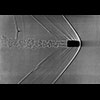
Supersonic Bullet
A bullet traveling through air at about 1.5 times the speed of sound can be seen in this image.
-
Mira's Tail There All Along
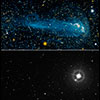
NASA's Galaxy Evolution Explorer discovered an exceptionally long comet-like tail of material trailing behind Mira -- a star that has been studied thoroughly for about 400 years.
-
NGC 362
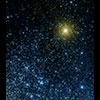
This image is a false color composite, where light detected by GALEX's far-ultraviolet detector is colored blue, and light from GALEX's near-ultraviolet detector is red.
-

Scene of Multiple Explosions
This composite image shows Z Camelopardalis, or Z Cam, a double-star system featuring a collapsed, dead star, called a white dwarf, and a companion star, as well as a ghostly shell around the system.
-

Classic Galaxy With Glamour
In a new ultraviolet image, the magnificent M81 spiral galaxy is shown at the center.
-

Growth by Interaction
This ultraviolet/visible-light composite image shows one-way galaxies may grow from interaction.
-
Nova Shell Around Z Camelopardalis
The larger image, a composite from the near-ultraviolet and far-ultraviolet detectors on NASA's Galaxy Evolution Explorer, shows the Z Camelopardalis (Z Cam) stellar system and a massive shell around it.
-
Scene of Multiple Explosions
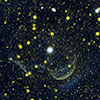
This composite image shows Z Camelopardalis, or Z Cam, a double-star system featuring a collapsed, dead star, called a white dwarf, and a companion star, as well as a ghostly shell around the system.
-
Ghostly Remnant of an Explosive Past
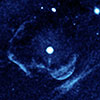
This enhanced image from the far-ultraviolet detector on NASA's Galaxy Evolution Explorer shows a ghostly shell of ionized gas around Z Camelopardalis, a binary, or double-star system featuring a collapsed, dead star known as a white dwarf, and a companion star.
-

The Stars of EF Eri
This artist's concept depicts subtle mass transfer between the stars of EF Eridanus, nicknamed EF Eri for short.
-
Black Hole Grabs Starry Snack
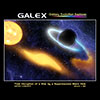
This artist's concept shows a supermassive black hole at the center of a remote galaxy digesting the remnants of a star.
-

An Unwelcome Place for New Stars
This artist's concept depicts a supermassive black hole at the center of a galaxy. NASA's Galaxy Evolution Explorer found evidence that black holes - once they grow to a critical size - stifle the formation of new stars in elliptical galaxies.
-
Big Black Holes Mean Bad News for Stars
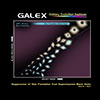
This diagram illustrates research from NASA's Galaxy Evolution Explorer showing that black holes - once they reach a critical size - can put the brakes on new star formation in elliptical galaxies.
-

Triple Scoop of Galactic Goodies
NASA's Galaxy Evolution Explorer dishes up a feast of cool cosmic treats from its first three years in orbit.
-
Silver Dollar Galaxy: NGC 253
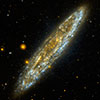
Located 10 million light-years away in the southern constellation Sculptor, the Silver Dollar galaxy, or NGC 253, is one of the brightest spiral galaxies in the night sky.
-
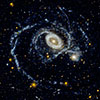
Gravitational Dance: NGC 1512 and NGC 1510
In this image, the wide ultraviolet eyes of NASA's Galaxy Evolution Explorer show spiral galaxy NGC 1512 sitting slightly northwest of elliptical galaxy NGC 1510.
-
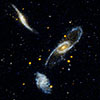
Galaxy Trio: NGC 5566, NGC 5560, and NGC 5569
NASA's Galaxy Evolution Explorer shows a triplet of galaxies in the Virgo cluster: NGC 5560 (top galaxy), NGC 5566 (middle galaxy), and NGC 5569 (bottom galaxy).
-
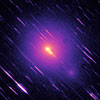
GALEX Sees Comet Machholz
The figure shows a GALEX NUV grism observation of comet Machholz, recorded on March 1, 2005.
-

Stellar Parties
Like confetti at a party, the diverse stellar populations of globular clusters NGC 1851 and 1904 display a spectacular range of colors in these three-channel composites.
-
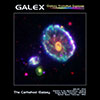
Multi-Wavelength With GALEX Header
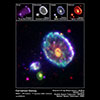
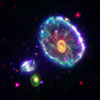
This false-color composite image shows the Cartwheel galaxy as seen by the Galaxy Evolution Explorer's Far Ultraviolet detector (blue); the Hubble Space Telescope's Wide Field and Planetary Camera-2 in B-band visible light (green); the Spitzer Space Telescope's Infrared Array Camera (IRAC) at 8 microns (red); and the Chandra X-ray Observatory's Advanced CCD Imaging Spectrometer-S array instrument (purple).
-
Multi-Wavelength With Insets
In this version, the insets above the composite show how each telescope individually views the Cartwheel galaxy.
-
Multi-Wavelength Composite Only
This false-color composite image shows the Cartwheel galaxy as seen by the Galaxy Evolution Explorer's Far Ultraviolet detector (blue); the Hubble Space Telescope's Wide Field and Planetary Camera-2 in B-band visible light (green); the Spitzer Space Telescope's Infrared Array Camera (IRAC) at 8 microns (red); and the Chandra X-ray Observatory's Advanced CCD Imaging Spectrometer-S array instrument (purple).
-

Ultraviolet Atlas of Nearby Galaxies Poster (Front)
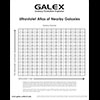
Galaxies from the atlas are arranged in bins of increasing ultraviolet color (the difference between far and near ultraviolet magnitude).
-
Ultraviolet Atlas of Nearby Galaxies Poster (Back)
Galaxies from the atlas are arranged in bins of increasing ultraviolet color (the difference between far and near ultraviolet magnitude).
-

Hello to Arms
This image highlights the hidden spiral arms (blue) that were discovered around the nearby galaxy NGC 4625 by the ultraviolet eyes of NASA's Galaxy Evolution Explorer.
-
Galactic Halos of Hydrogen
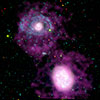
This image shows two companion galaxies, NGC 4625 (top) and NGC 4618 (bottom), and their surrounding cocoons of cool hydrogen gas (purple).
-
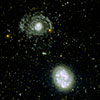
Look at My Arms!
This image shows the hidden spiral arms that were discovered around the galaxy called NGC 4625 (top) by the ultraviolet eyes of NASA's Galaxy Evolution Explorer.
-

Dwarf Star Erupts in Giant Flare
This movie taken by NASA'S Galaxy Evolution Explorer show one of the largest flares, or star eruptions, ever recorded at ultraviolet wavelengths.
-
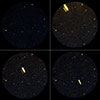
It's Not a Bird or a Plane
Galaxies aren't the only objects filling up the view of NASA's Galaxy Evolution Explorer.
-
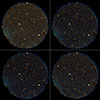
Surprise Ultraviolet Party in the Sky
Galaxies aren't the only objects filling up the view of NASA's Galaxy Evolution Explorer.
-

NGC 1097
Ultraviolet image of the interacting pair NGC 1097, a barred spiral galaxy, and the small elliptical companion galaxy NGC 1097A.
-
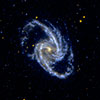
NGC 1365
Ultraviolet image of the barred spiral galaxy NGC 1365, which is a member of the Fornax Cluster of Galaxies.
-
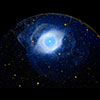
Helix Nebula
Ultraviolet image of the planetary nebula NGC 7293 also known as the Helix Nebula.
-
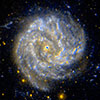
M83
Ultraviolet image of the nearby "Southern Pinwheel" galaxy M83 (NGC 5236).
-
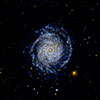
NGC 3344
Ultraviolet image of the large face on spiral galaxy NGC 3344.
-
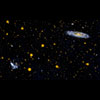
Stephan's Quintet and NGC 7331
Ultraviolet image of the interacting group of galaxies known as Stephan's Quintet (NGC7317, NGC7318A, NGC7318B, NGC7319, NGC7320, lower left).
-
Virgo Galaxy Cluster
Ultraviolet image of a small area of the Virgo Cluster of galaxies.
-
NGC 3190 Field
Ultraviolet image of a diverse group of galaxy types.
-
NGC 1851
Ultraviolet image of the globular cluster NGC 1851 in the southern constellation Columba.
-
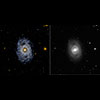
NGC 3351 (M95)
Ultraviolet image (left) and visual image (right) of the face on barred and ringed spiral galaxy NGC 3351 (M95).
-
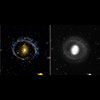
NGC 1291
Ultraviolet image (left) and visual image (right) of the barred ring galaxy NGC 1291.
-
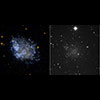
IC 1613
Ultraviolet image (left) and visual image (right) of the irregular dwarf galaxy IC 1613.
-
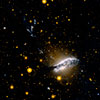
NGC 5128 (Centaurus-A)
Ultraviolet image of NGC 5128 (Centaurus-A).
-
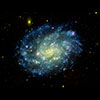
Classic Galaxy With Glamour
This color composite image of nearby NGC 300 combines the visible-light pictures from Carnegie Institution of Washington's 100-inch telescope at Las Campanas Observatory (colored red and yellow), with ultraviolet views from NASA's Galaxy Evolution Explorer.
-

The Galaxy Evolution Explorer
The Galaxy Evolution Explorer was launched on April 28, 2003.
-
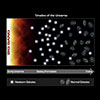
Baby Galaxies in an Adult Universe
This artist's conception illustrates the decline in our universe's "birth-rate" over time.
-
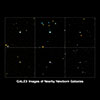
Nearby Newborns
This image shows six of the three-dozen "ultraviolet luminous galaxies" spotted in our corner of the universe by NASA's Galaxy Evolution Explorer.
-
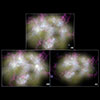
Fires of Galactic Youth
These artist animation stills show a typical young galaxy, teeming with hot, newborn stars and exploding supernovas. The supernovas are seen as white flashes of light.
-
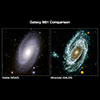
A Galaxy in Different Lights
This side-by-side comparison shows the nearby galaxy Messier 81, which is similar to our own Milky Way, in both visible (left) and ultraviolet light (right).
-
How to Spot a Young Galaxy
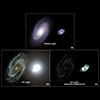
These animation stills demonstrate that young galaxies are best viewed in ultraviolet light.
-
Field of View Image
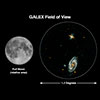
The Galaxy Evolution Explorer specializes in surveying galaxies in ultraviolet light.